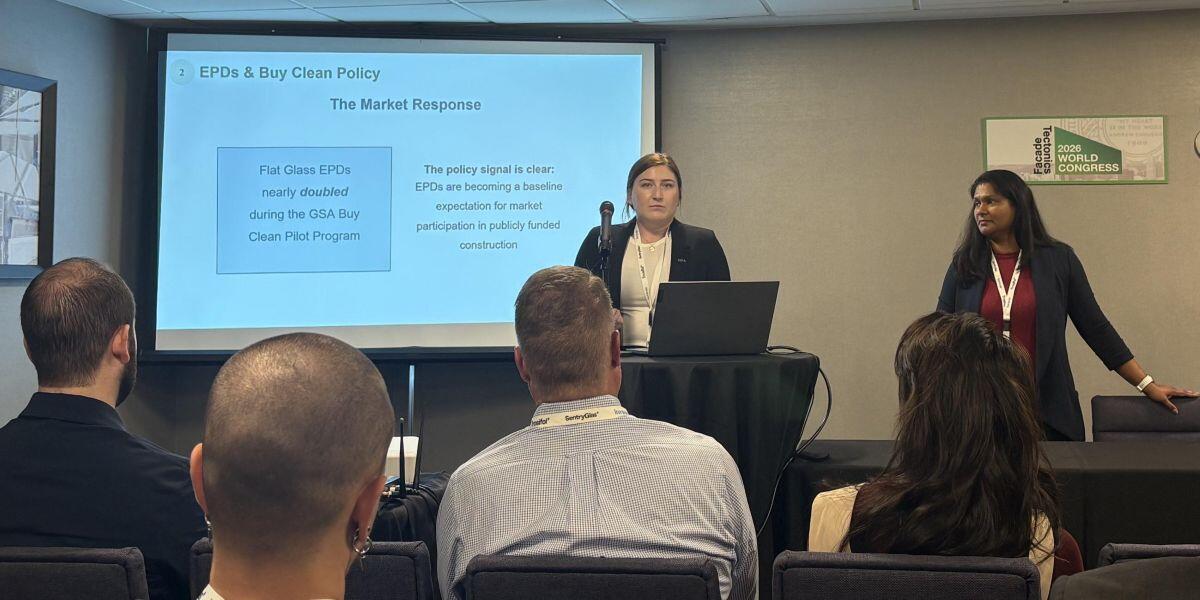
The Façade Tectonics Institute (FTI) held its 2026 World Congress in Pittsburgh, Sept. 28–Oct. 2, drawing approximately 300 registered building and design professionals focused on façade materials, design, and performance. FTI received more than 130 abstract submissions from around the world, a record level of engagement for the event.
Carnegie Mellon University’s School of Architecture hosted this year’s World Congress, including a robotics and construction workshop and a reception at the CMU College of Fine Arts. Eighty CMU students attended the presentations.
NGA at FTI
On Sept. 30, Urmilla Sowell, NGA’s vice president of advocacy and technical services, and Georgia Oehler, senior manager of technical services and sustainability, presented a paper on industry-wide sustainability efforts. Their presentation examined three concurrent initiatives that show how collaboration within the architectural glass industry, and with its partners, is addressing systemic sustainability gaps in North America:
- EPD development. The rapid growth of environmental product declarations in the glass sector shows both the power of standardized disclosure to drive meaningful carbon reductions and its limits.
- Recycling visibility. NGA’s World of Glass Map and technical papers bring clarity to a fragmented recycling system, showing where infrastructure exists and highlighting gaps by geography and material type.
- Recycling research. A joint project between NGA and the Aluminum Extruders Council brings together manufacturers, processors, and waste management organizations to quantify recycling barriers and identify scalable solutions.
The takeaway across all three: sustainability progress in architectural glass can’t come from any one company or sector acting alone. It requires coordinated action across the full supply chain, from raw material extraction through building decommissioning.